The big picture
RabbitMQ is a message-queuing system, also known as a message broker, that enables applications, services, and devices to communicate with each other efficiently, reliably, and asynchronously.
What does RabbitMQ do?
RabbitMQ acts as a middleman between different parts of your system. Instead of sending data directly to each other, applications send messages to RabbitMQ, which safely stores and forwards them to the right destination when ready.
This model follows the Producer → Broker → Consumer pattern:
- The Producer creates and sends messages.
- The Broker (RabbitMQ) receives, stores, and routes messages.
- The Consumer retrieves and processes them.
This approach allows for asynchronous communication, meaning producers and consumers don’t have to run at the same time. The result: systems that are more responsive, fault-tolerant, and scalable.
How RabbitMQ works
RabbitMQ uses the Advanced Message Queuing Protocol (AMQP) and is built around a few core concepts:
-
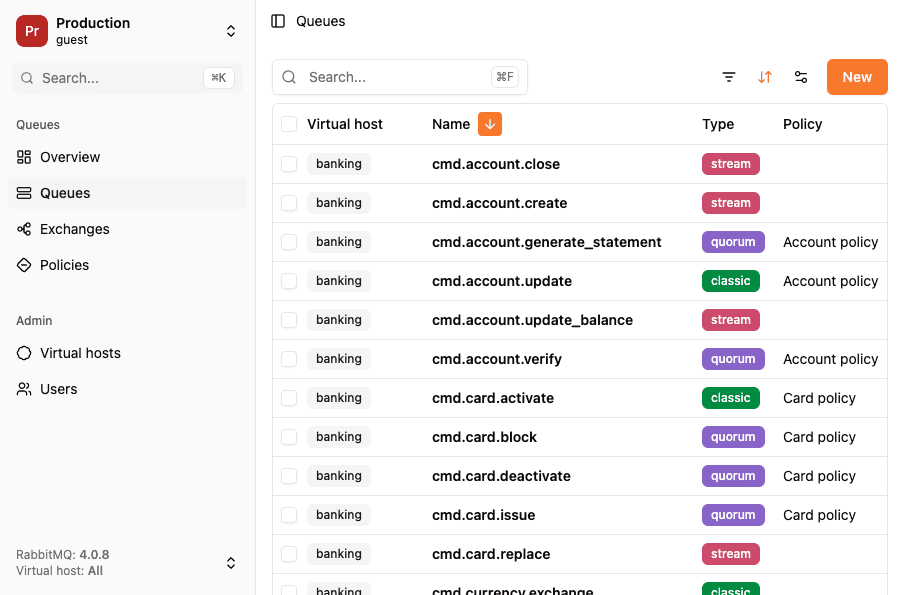
Queues: A queue is where messages are stored until they are processed. Think of it as a “to-do list” for your system’s background workers.
-
Exchanges: Exchanges are routers that decide how messages move through the system. They use routing keys and bindings to direct messages to the right queues. See RabbitMQ exchange types explained for how each type routes messages.
-
Bindings: Bindings define the rules that connect exchanges to queues. They control message flow and make routing flexible.
-
Routing keys: Routing keys let you send messages selectively, for instance, to multiple queues or only specific ones.
This architecture supports both simple and complex messaging patterns, including point-to-point, publish/subscribe, and topic-based communication.
Why use RabbitMQ?
RabbitMQ’s popularity stems from its ability to make systems more reliable, scalable, and easier to maintain. Here are the main advantages:
-
Asynchronous task handling: Offload heavy operations, such as sending emails, generating reports, or resizing images, to background workers without blocking the main application.
-
Decoupled architecture: RabbitMQ reduces tight coupling between services. Each component only needs to know how to send or receive messages, not the details of the other parts.
-
Reliability and durability: RabbitMQ supports message acknowledgments, persistence, and replication, ensuring that no messages are lost even if a system fails.
-
Flexible message routing: With multiple exchange types (direct, topic, fanout, headers), RabbitMQ allows developers to design complex workflows and distribution patterns.
-
Multi-protocol and cross-language support: RabbitMQ supports protocols like AMQP, MQTT, and STOMP, with client libraries available for popular languages like Python, Java, Node.js, Go, and C#, making it platform-agnostic.
Real-world use cases of RabbitMQ
RabbitMQ fits naturally into any system that needs reliable communication between distributed components. Common use cases include:
- Microservice communication: Decoupling services for greater flexibility.
- Task queues: Handling background jobs like notifications or data processing.
- IoT data streaming: Collecting and buffering sensor data.
- Real-time apps: Broadcasting updates, such as chat messages or live dashboards.
- Load balancing: Distributing work evenly across multiple worker services.
RabbitMQ vs. modern alternatives
While modern systems like Apache Kafka are often used for large-scale event streaming, RabbitMQ remains a proven and versatile solution for message queuing.
Kafka focuses on throughput and event persistence, while RabbitMQ emphasizes reliability, interoperability, and simplicity. It’s especially effective for task processing, RPC workflows, and traditional enterprise integration scenarios.
Key takeaways
- RabbitMQ is a robust, open-source message broker for asynchronous communication.
- It follows a producer-exchange-queue-consumer model to decouple and simplify system components.
- Its routing flexibility, durability, and multi-protocol support make it ideal for a wide range of use cases.
- It’s perfect for microservices, distributed systems, and background processing where reliability and scalability matter most.
Final thoughts
RabbitMQ continues to be one of the most reliable and widely adopted message brokers in the world. Whether you’re building scalable microservices or optimizing a monolithic app, RabbitMQ provides the backbone for safe, asynchronous, and efficient communication between your systems. When you move to production, our RabbitMQ best practices checklist is a practical next read.